My main research connects therapeutic peptide evidence mining, data integration and machine learning. Complementary projects extend this experience to antibodies, proteins and small molecules.
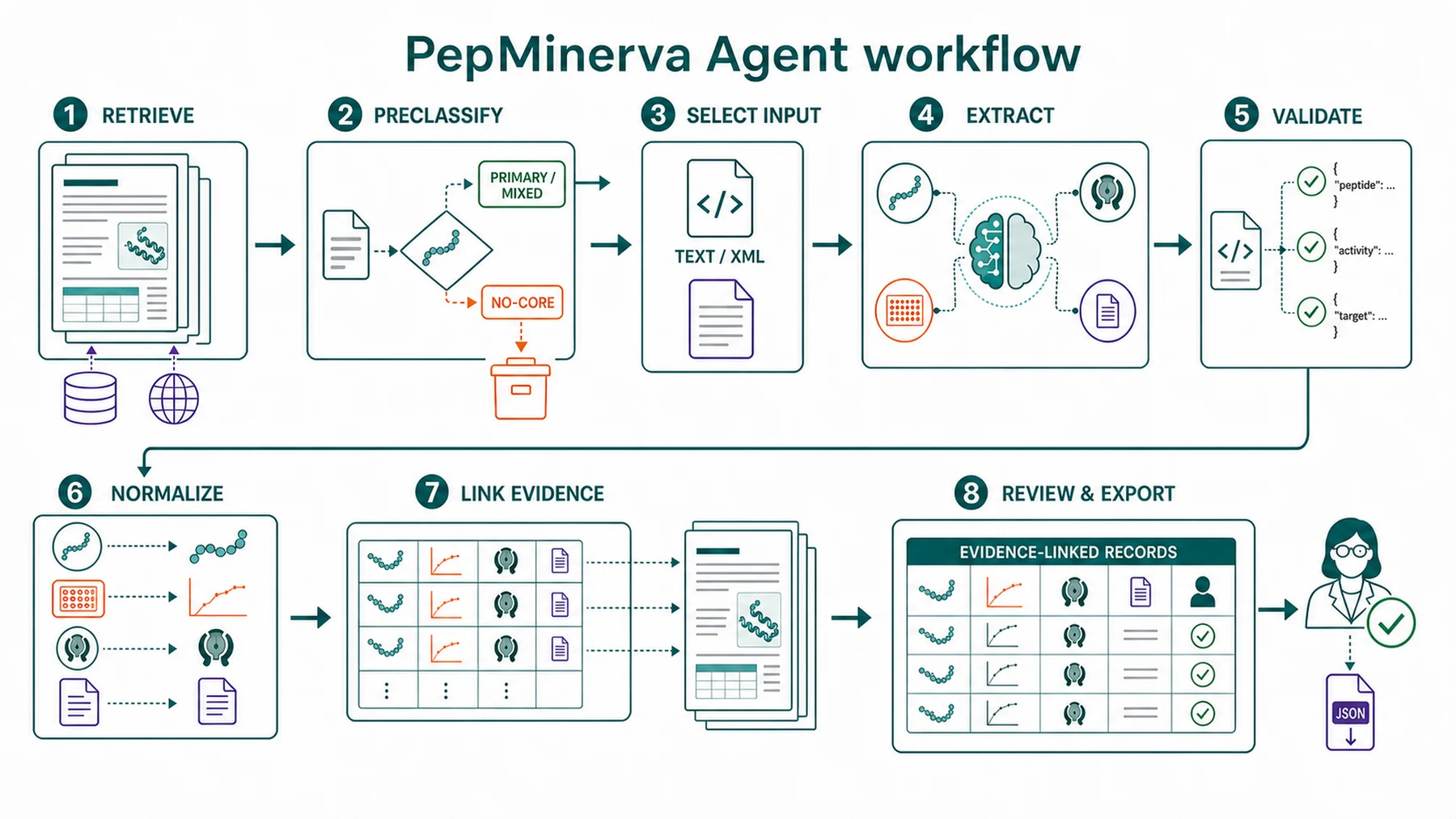
How can therapeutic peptide entities and activity measurements be recovered from full-text papers while retaining links to their evidence?
Approach & contribution
Designed and implemented retrieval, full-text parsing, content routing, structured extraction and evidence linking. Built and annotated the Gold50 benchmark; compared three model backends and two processing routes. Developed the CLI and Agent Skill interface, conducted evaluations and drafted the manuscript.
Evidence & scope
Gold50 contains 50 papers, 165 peptide entities and 746 activity records. Record-level F1 was 0.843 in the frozen full-text workflow, including fallback processing. This measures record detection and matching, not complete-field accuracy.
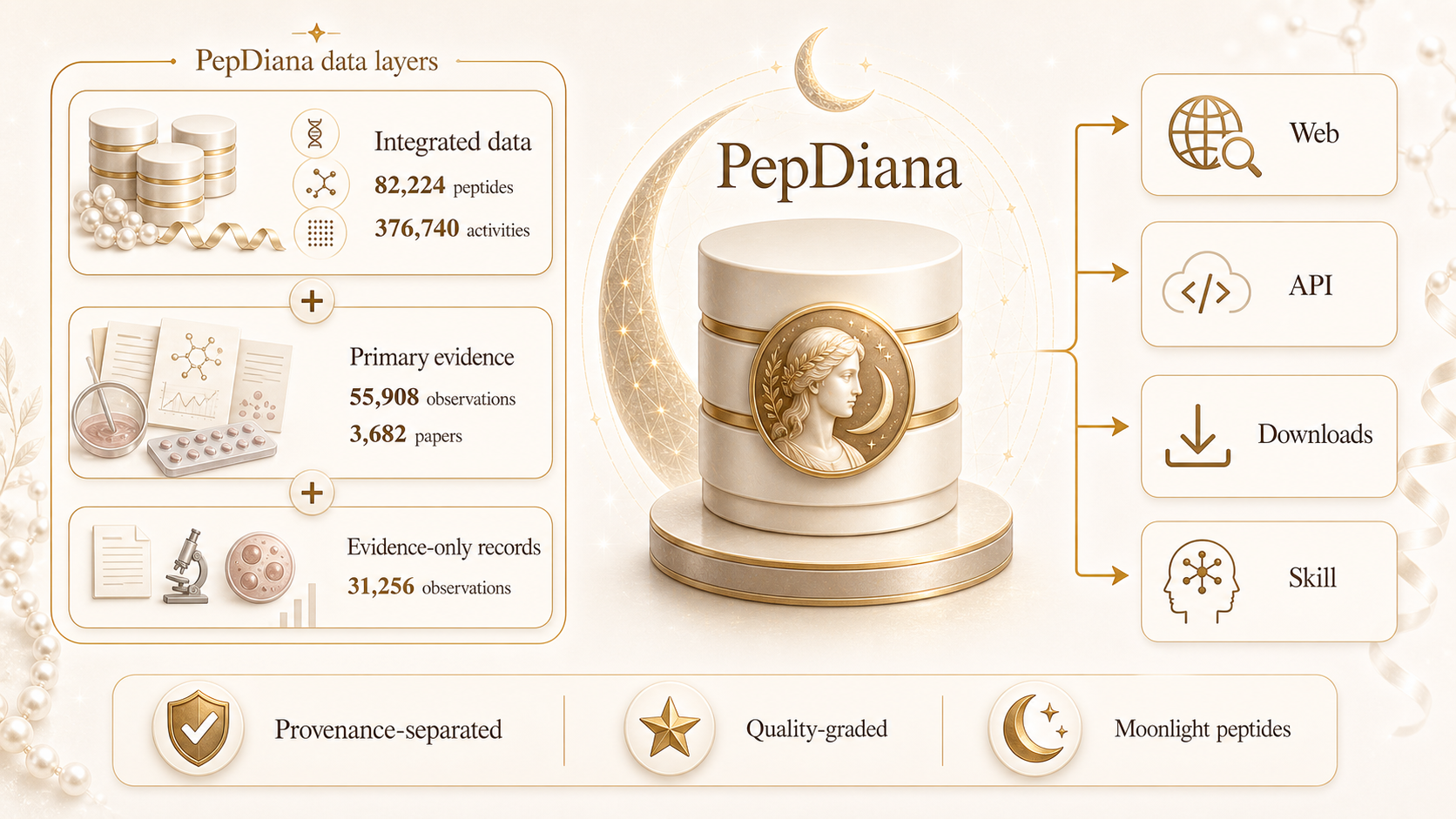
How can heterogeneous peptide records be integrated without losing the distinction between aggregated database entries and primary literature evidence?
Approach & contribution
Led data integration from existing databases and PepMinerva literature extractions. Independently developed data processing, backend services, APIs and frontend interfaces, and deployed and maintained the website.
Evidence & scope
The June 2026 integrated layer contains 82,224 peptide records and 376,740 activity observations. These are aggregated records, not newly performed experiments. The initial website is online; display and field-level revisions and manuscript preparation are ongoing.
Project architecture. Original figure labels are in English. Original project figure, June 2026; counts refer to separate data layers. View full-size figure ↗
03 / Predictive modelling
Bilingua-DPP-IV
2024.11–2025.06
Accepted · ChemMedChem
Lead research and software development · First author
Learning from sequence and molecular representations
Research question
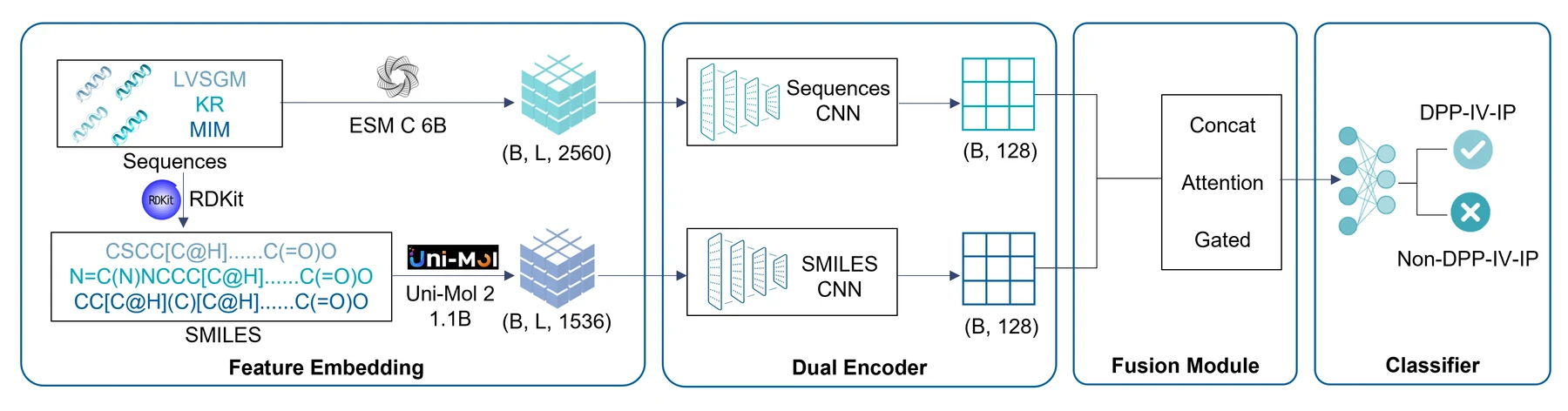
Can pretrained sequence and molecular representations be combined to classify DPP-IV inhibitory peptides?
Approach & contribution
Curated the peptide data and developed a dual-branch convolutional network with gated fusion using ESM-C and Uni-Mol2 representations. Performed training, comparative evaluation and ablations; implemented and deployed the web interface and backend, and drafted the paper.
Evidence & scope
MCC 0.764 and ROC AUC 0.963 on a stratified random holdout set of 300 records. These are computational classification results under this split, not proof of activity for newly designed peptides. Accepted by ChemMedChem on 11 October 2026; not yet online.
Biotechnology startup · Doctoral research internship
Developed an anti-TSLP CDR-redesign workflow using RFantibody/RFdiffusion, ProteinMPNN and structure prediction. Evaluated confidence, interfaces and ranking consistency; delivered candidates, Slurm workflows and reports to the experimental team.
Analysed protein conformations and antigen–antibody interfaces. Prepared structural reports and delivered theoretical and practical training on AlphaFold2, molecular dynamics and protein developability.
2022.09–2025.07
Fluorescent probe engineering
MatC-based malate probes · Collaborative research
Contributed to Rosetta-based binding-pocket variant design and candidate selection, incorporating collaborators’ fluorescence measurements into iterative analysis.
2023
Small-molecule screening
NMDA receptors · Computational biology competition team project
Participated in GluN1/GluN3A-targeted screening. The team combined deep-learning screening, docking and MM/GBSA. Experimental feedback reported three candidates with IC50 below 100 μM (minimum 2.45 μM), providing preliminary signals for retesting.